
How to Improve Futsal Skills at Home: The Ultimate Training Guide
Want to become a better futsal player but don’t always have access to a court, coach, or teammates?
You’re not alone. Many players struggle to find enough time for structured training sessions. The good news is that some of the most important futsal skills can be developed right at home.
In fact, learning how to improve futsal skills at home is one of the fastest ways to build better ball control, footwork, passing accuracy, and confidence. In this guide, you’ll discover practical futsal training drills at home, solo practice routines, beginner-friendly exercises, and expert tips used by elite players to sharpen their game.
How to Improve Futsal Skills at Home?
To improve futsal skills at home, focus on daily ball control drills, sole touches, passing against a wall, close-control dribbling, quick footwork exercises, and shooting accuracy practice. Consistent 20–30 minute training sessions can significantly improve technique, reaction speed, and confidence even without access to a futsal court.
What Is Home Futsal Training?
Home futsal training is the process of developing futsal-specific skills in a small space such as a garage, backyard, driveway, indoor room, or local park.
Unlike traditional football training, futsal emphasizes:
- Close ball control
- Quick decision-making
- Fast passing
- Tight-space dribbling
- Fast footwork.
Because futsal is played in compact spaces, many of its training exercises can be replicated effectively at home.
Why Is Improving Futsal Skills at Home Important?
The best futsal players don’t only improve during matches.
They improve during daily repetition.
Home training allows players to:
- Get more touches on the ball
- Develop muscle memory
- Improve confidence
- Practice consistently
- Accelerate skill development.
Research in sports science consistently shows that frequent skill repetition is one of the biggest factors influencing technical improvement.
Key Benefits of Home Futsal Training
More Ball Touches
Players can accumulate thousands of additional touches each week through home practice.
More touches equal faster improvement.
Better Ball Control
Regular drills improve:
- First touch
- Sole control
- Receiving skills
- Ball manipulation.
Improved Confidence
Players who train consistently feel more comfortable during matches.
Confidence often comes from preparation.
Faster Footwork
Quick feet are essential in futsal.
Home drills help improve:
- Agility
- Coordination
- Balance
- Speed.
Cost-Effective Development
You don’t need expensive facilities.
A ball and small training space are often enough.
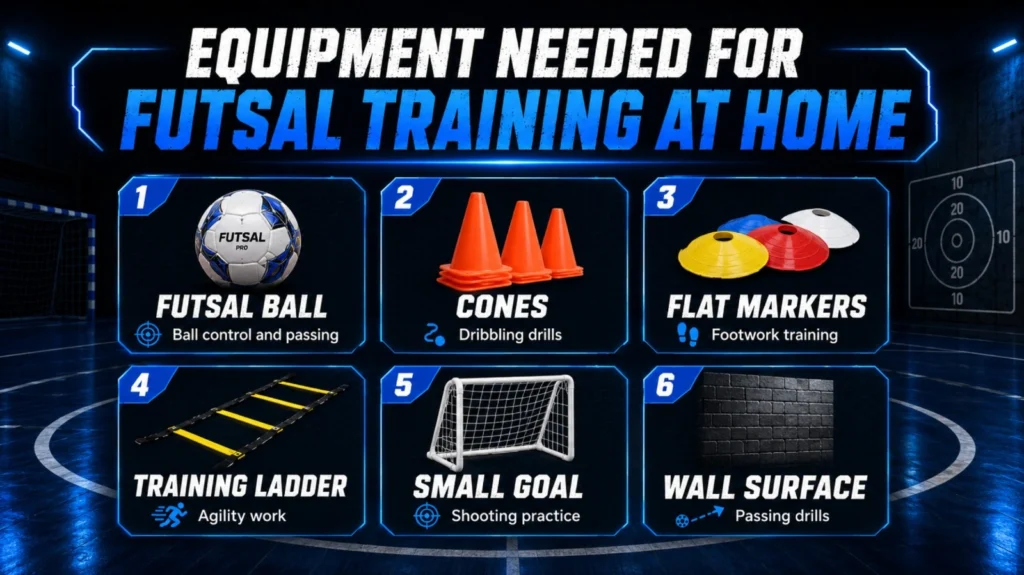
Equipment Needed for Futsal Training at Home
| Equipment | Purpose |
| Futsal Ball | Ball control and passing |
| Cones | Dribbling drills |
| Flat Markers | Footwork training |
| Training Ladder | Agility work |
| Small Goal | Shooting practice |
| Wall Surface | Passing drills |
Choosing a Futsal Ball Australia
If you’re purchasing a futsal ball Australia, consider:
- FIFA-approved models
- Low-bounce construction
- Durable outer material
- Proper size for age group.
A quality futsal ball helps players develop realistic match-specific skills.
AZU Sports offers performance-focused equipment designed for futsal training and player development.
How Does Home Futsal Training Work?
Futsal improvement comes from consistent repetition of key movements.
The process typically follows four stages:
Stage 1: Ball Familiarity
Learn to control the ball naturally.
Stage 2: Technical Development
Improve passing, dribbling, and receiving.
Stage 3: Speed Training
Increase execution speed.
Stage 4: Match Simulation
Perform skills under pressure and fatigue.
Step-by-Step Guide – How to Improve Futsal Skills at Home
Step 1: Master Sole Touches
The sole of the foot is heavily used in futsal.
Drill
- Roll ball forward
- Pull back with sole
- Repeat continuously.
Duration:
3 sets × 60 seconds
Benefits:
- Better control
- Improved balance
- Enhanced touch.
Step 2: Inside-Outside Touches
This develops quick directional changes.
Drill
Touch the ball:
- Inside of foot
- Outside of foot.
Repeat rapidly.
Duration:
3 sets × 1 minute
Step 3: Wall Passing Drill
One of the most effective solo exercises.
Drill
Pass against a wall and receive with:
- Right foot
- Left foot
- Sole
- Inside touch.
Duration:
10 minutes
Benefits:
- Passing accuracy
- First touch
- Reaction speed.
Step 4: Figure-8 Dribbling
Place two cones 2 meters apart.
Dribble around them continuously.
Focus on:
- Tight control
- Quick turns
- Head-up dribbling.
Step 5: Toe Tap Drill
Alternate feet on top of the ball.
Perform quickly.
Duration:
3 sets × 45 seconds
Benefits:
- Coordination
- Foot speed
- Agility.
Step 6: Quick Direction Changes
Set up four markers.
Dribble to each marker while changing direction rapidly.
This simulates game situations.
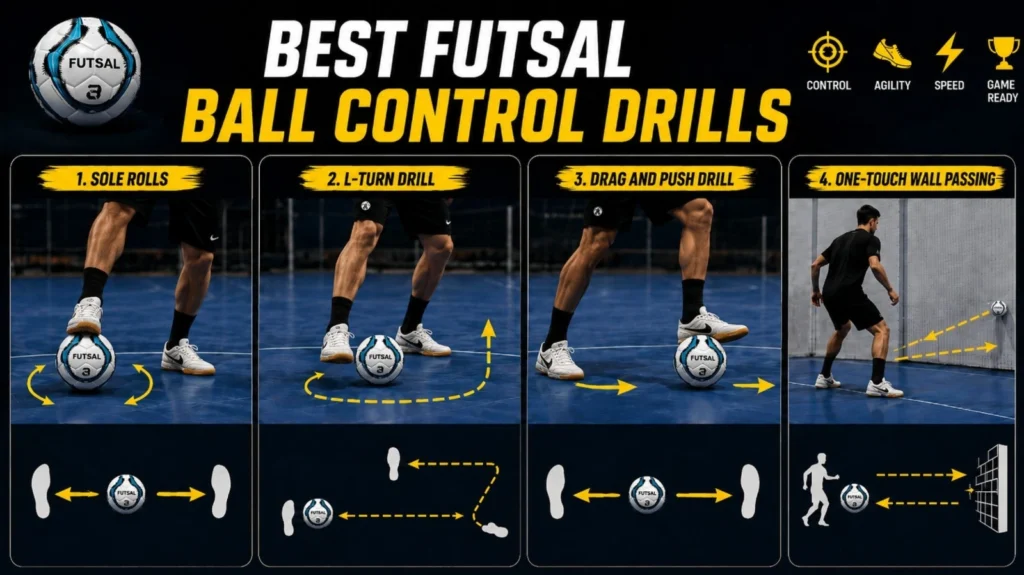
Best Futsal Ball Control Drills
Sole Rolls
Excellent for learning traditional futsal movements.
L-Turn Drill
A fundamental move used by professional futsal players.
Benefits:
- Shielding
- Turning
- Escaping pressure.
Drag and Push Drill
Use the sole to drag the ball and push away.
Perfect for small-space control.
One-Touch Wall Passing
Develops quick thinking and execution.
Triangle Control Drill
Use three markers.
Move continuously between them while controlling the ball.
Futsal Skills for Beginners
If you’re new to futsal, focus on these core skills first.
Ball Control
The foundation of everything.
Passing Accuracy
Accurate passing creates opportunities.
First Touch
A good first touch buys time and space.
Movement Without the Ball
Learn to create passing angles.
Basic Shooting
Develop accuracy before power.
How to Practice Futsal Alone
Many players wonder:
Can I improve futsal by myself?
Absolutely.
Solo training is one of the most effective development methods.
Solo Training Ideas
- Wall Passing
- Hundreds of repetitions daily.
- Cone Dribbling
- Improve close control.
- Juggling
- Develop touch and coordination.
- Shadow Movement
- Practice positioning without a ball.
- Ball Mastery Routines
- Train technical skills efficiently.
Indoor Football Training at Home
Indoor football training is ideal when outdoor conditions are poor.
Best Indoor Drills
Toe Taps
Require minimal space.
Sole Pulls
Perfect for apartments.
Stationary Ball Mastery
Develop touch safely indoors.
Passing Against Soft Rebounders
Improve receiving skills.
Agility Ladder Drills
Enhance foot speed.
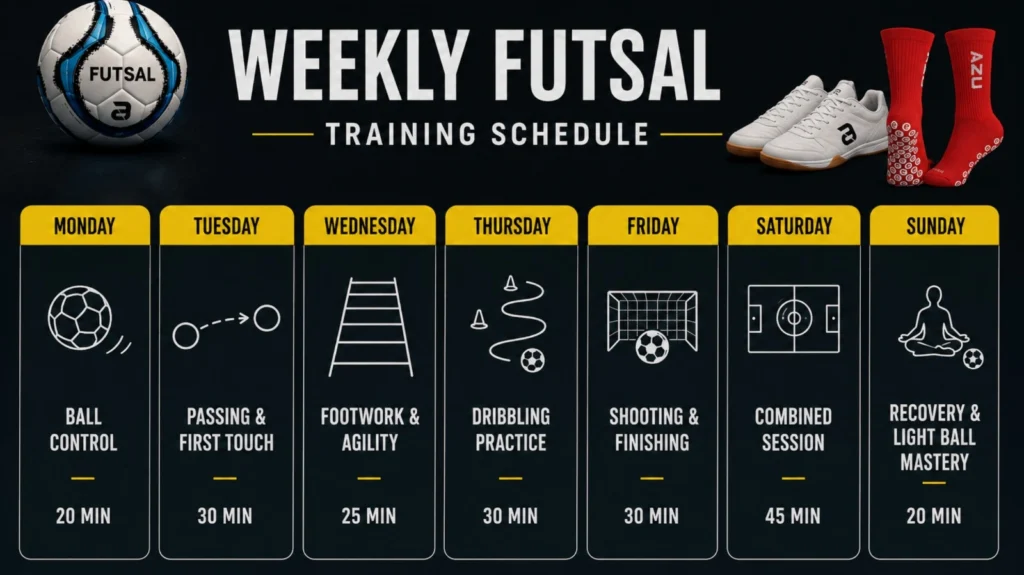
Weekly Futsal Training Schedule
Monday
Ball Control
20 Minutes
Tuesday
Passing & First Touch
30 Minutes
Wednesday
Footwork & Agility
25 Minutes
Thursday
Dribbling Practice
30 Minutes
Friday
Shooting & Finishing
30 Minutes
Saturday
Combined Session
45 Minutes
Sunday
Recovery & Light Ball Mastery
20 Minutes
Comparison Table – Home Futsal Training vs Team Training
| Factor | Home Training | Team Training |
| Ball Touches | Very High | Moderate |
| Cost | Low | Higher |
| Convenience | Excellent | Fixed Schedule |
| Tactical Learning | Limited | Excellent |
| Skill Repetition | Excellent | Good |
| Match Experience | None | Excellent |
The best players combine both approaches.
Common Mistakes to Avoid
Training Without a Plan
Random practice produces slower results.
Ignoring Weak Foot Development
Train both feet equally.
Practicing Too Fast Too Early
Master technique first.
Speed comes later.
Using a Soccer Ball Instead of a Futsal Ball
A futsal ball provides realistic training feedback.
Skipping Recovery
Rest is essential for improvement.
Expert Tips for Faster Improvement
Train Daily
Consistency beats intensity.
Focus on Quality Repetitions
Perfect practice creates perfect habits.
Record Your Sessions
Video analysis helps identify weaknesses.
Use Match-Speed Movements
Train as you play.
Challenge Yourself
Gradually increase difficulty.
Best Practices for Home Futsal Development
Create a Dedicated Training Area
Consistency becomes easier.
Track Progress
Measure:
- Touch count
- Passing accuracy
- Drill completion time.
Set Weekly Goals
Small goals create long-term improvement.
Practice Under Pressure
Use time limits and targets.
FAQs
Q1: Can I improve futsal skills without a coach?
A: Yes. Structured drills and consistent practice can significantly improve technical abilities.
Q2: Is juggling important in futsal?
A: Juggling improves touch, coordination, and ball awareness.
Q3: What is the best futsal drill for beginners?
A: Wall passing is one of the simplest and most effective beginner drills.
Q4: What are the best futsal ball control drills?
A: Sole rolls, wall passing, L-turns, and figure-8 dribbling.
Q5: What size futsal ball should I use?
A: Most adults use Size 4 futsal balls.
Q6: Does futsal improve soccer performance?
A: Yes. Many professional footballers use futsal to sharpen technical skills.
Q7: How much space do I need?
A: Many drills require only a few square meters.
Q8: How quickly will I improve?
A: Most players notice improvements within a few weeks of consistent practice.
Q9: What is the most important futsal skill?
A: Ball control is often considered the foundation of success.
Q10: Can adults start learning futsal?
A: Yes. Players of all ages can enjoy and improve at futsal.
Conclusion
Learning how to improve futsal skills at home doesn’t require expensive facilities or professional coaching. With the right drills, consistent effort, and a quality futsal ball, players can dramatically improve ball control, footwork, passing accuracy, and confidence.
The key is simple: train regularly, focus on fundamentals, and gradually increase the challenge of your sessions.
Every great futsal player started with the basics. Master them at home, and you’ll see the difference on the court.
Ready to elevate your game?
Explore AZU Sports’ range of premium futsal balls, training equipment, and performance gear designed to help players train smarter, develop faster, and perform with confidence. Whether you’re a beginner or an experienced player, AZU Sports has the tools you need to take your futsal skills to the next level.