
Futsal vs Soccer: What Is the Difference?
If you’ve ever watched a fast-paced indoor futsal match and wondered how it compares to traditional soccer, you’re not alone.
Many players, coaches, and parents ask the same question: futsal vs soccer what is the difference?
The answer is simple: while both sports share similar fundamentals, they differ significantly in playing surface, team size, ball design, rules, pace, and player development benefits.
In this guide, you’ll learn exactly how futsal and soccer compare, which game is better for skill development, and why many professional footballers credit futsal for helping them reach elite levels.
What Is Futsal?
Futsal is a fast-paced indoor football game played between two teams of five players each on a hard court using a smaller, low-bounce ball.
The name comes from the Spanish phrase “fútbol sala” which means “hall football.”
Key Characteristics of Futsal
- 5 players per team
- Indoor hard court
- Smaller playing area
- Low-bounce futsal ball
- Unlimited substitutions
- Fast gameplay
- Emphasis on technique and ball control.
Futsal is officially recognized by FIFA and is played professionally worldwide.
What Is Soccer?
Soccer, also known as football in many countries, is played outdoors on a grass or artificial turf field with 11 players per side.
It is the world’s most popular sport, featuring major competitions such as the FIFA World Cup, UEFA Champions League, and domestic leagues.
Key Characteristics of Soccer
- 11 players per team
- Large outdoor field
- Standard soccer ball
- Longer matches
- More tactical positioning
- Greater emphasis on endurance and athleticism.
The main difference between futsal and soccer is that futsal is played indoors with five players per team using a smaller low-bounce ball, while soccer is played outdoors with eleven players per team using a standard soccer ball. Futsal emphasizes close control, quick passing, and technical skills, whereas soccer focuses more on positioning, endurance, and tactical play.
Difference Between Futsal and Soccer
Comparison Table
| Feature | Futsal | Soccer |
| Players Per Team | 5 | 11 |
| Playing Surface | Indoor Court | Grass/Turf Field |
| Ball Type | Low Bounce | Standard Bounce |
| Match Length | 40 Minutes | 90 Minutes |
| Substitutions | Unlimited | Limited |
| Goal Size | Smaller | Larger |
| Field Size | Small | Large |
| Pace of Play | Very Fast | Moderate |
| Ball Touches | High | Lower |
| Physical Contact | Less | More |
| Skill Development | Excellent | Good |
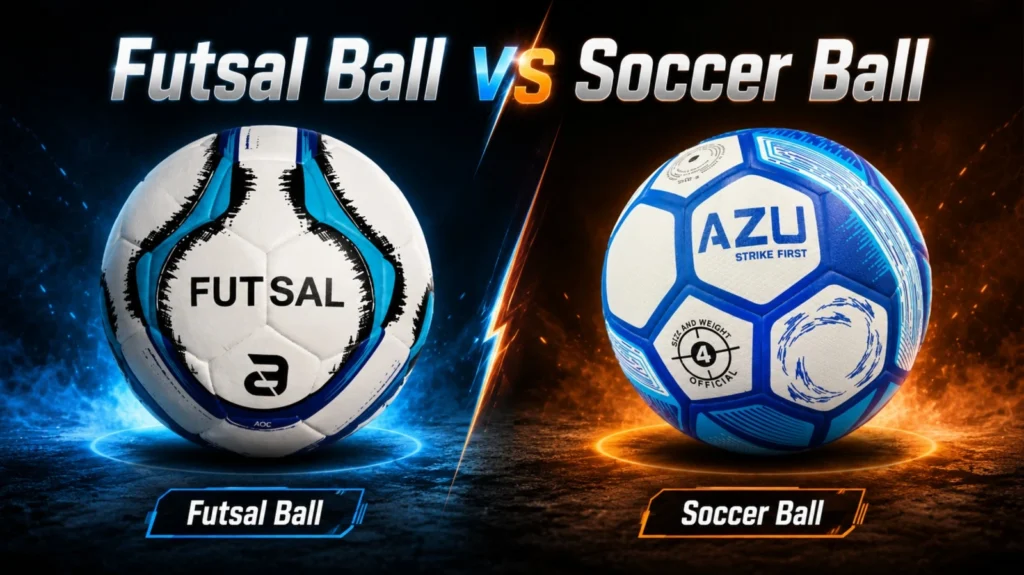
Futsal Ball vs Soccer Ball
One of the biggest differences is the ball itself.
| Feature | Futsal Ball | Soccer Ball |
| Size | Slightly Smaller | Standard |
| Bounce | Low Bounce | Higher Bounce |
| Control | Easier | Harder |
| Passing | More Accurate | Standard |
| Surface | Indoor Optimized | Outdoor Optimized |
Why Does a Futsal Ball Have Less Bounce?
A futsal ball is specifically designed to stay closer to the ground.
This encourages:
- Better control
- Faster passing
- More technical play
- Improved first touch.
Players receive significantly more touches compared to traditional soccer.
Choosing a Futsal Ball Australia
When shopping for a futsal ball Australia, look for:
- FIFA-approved certification
- Low-rebound construction
- Durable outer casing
- Consistent flight performance
- Proper size based on age group.
AZU Sports offers quality futsal equipment designed to support player development at all levels.
Futsal vs Soccer Rules
Although both sports share common principles, several rules differ.
Kick-Ins vs Throw-Ins
Futsal
The ball is returned using a kick-in.
Soccer
The ball is returned using a throw-in.
Kick-ins help players develop passing accuracy under pressure.
Fouls
Futsal uses an accumulated foul system.
After a certain number of fouls, the opposing team receives a direct scoring opportunity.
This encourages cleaner play.
Offside Rule
Futsal
No offside rule.
Soccer
Uses the offside rule.
Without offsides, futsal creates more attacking opportunities and faster transitions.
Why Is Futsal Important?
Futsal is often described as one of the best player development tools available.
Many legendary footballers began their journey playing futsal.
Notable examples include:
- Lionel Messi
- Cristiano Ronaldo
- Neymar
- Ronaldinho.
These players have publicly acknowledged how futsal improved their technical abilities.
Is Futsal Good for Soccer Players?
Yes. Futsal is extremely beneficial for soccer players because it develops ball control, quick decision-making, spatial awareness, passing accuracy, and confidence under pressure.
Benefits for Soccer Players
Improved Ball Control
Players receive significantly more touches per game.
This accelerates technical development.
Faster Decision-Making
Limited space forces quick thinking.
Players learn to react instantly.
Better First Touch
The low-bounce ball demands precision.
Poor touches are immediately punished.
Enhanced Passing Skills
Players learn:
- Short passing
- Combination play
- Quick movement.
Increased Confidence
More involvement leads to faster improvement and greater confidence.
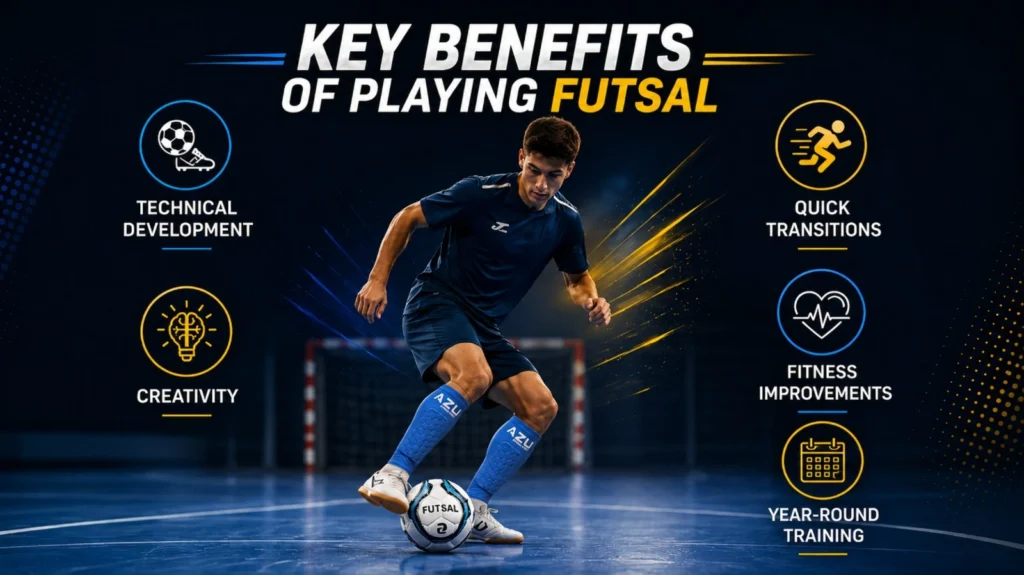
Key Benefits of Playing Futsal
Technical Development
Players constantly work on:
- Dribbling
- Passing
- Shooting
- Ball mastery.
Creativity
Small spaces encourage innovation and problem-solving.
Quick Transitions
Players learn to switch instantly between attack and defense.
Fitness Improvements
Futsal develops:
- Agility
- Speed
- Coordination
- Reaction time.
Year-Round Training
Indoor courts allow consistent training regardless of weather conditions.
Common Mistakes Players Make
Using Soccer Techniques Without Adjustment
Futsal requires quicker movements and tighter control.
Ignoring Defensive Responsibilities
Every player must defend.
There is little room for passengers.
Holding the Ball Too Long
Quick passing is essential.
Using the Wrong Ball
A soccer ball does not provide the same training benefits as a futsal ball.
Standing Still After Passing
Movement off the ball is crucial in futsal.
Expert Tips for Futsal Success
Focus on Your First Touch
A quality first touch creates space instantly.
Play One-Touch When Possible
Quick passing increases tempo.
Scan Constantly
Look around before receiving the ball.
Practice Sole Control
The sole of the foot is heavily used in futsal.
Use Proper Equipment
Invest in quality futsal footwear and balls from trusted suppliers like AZU Sports.
Best Practices for Players and Coaches
For Players
- Train consistently
- Work on weak foot skills
- Improve reaction speed
- Develop passing accuracy.
For Coaches
- Encourage creativity
- Focus on small-sided games
- Prioritize technique over physicality
- Create game-realistic scenarios.
FAQs
Q1: Is futsal harder than soccer?
A: Futsal is often considered more technically demanding because players have less time and space to make decisions.
Q2: Why do soccer players play futsal?
A: Many players use futsal to improve technical skills, decision-making, ball control, and confidence.
Q3: Does futsal improve dribbling?
A: Yes. Tight spaces force players to develop close control and effective dribbling techniques.
Q4: What size futsal ball should I use?
A: Size depends on age, but adults typically use a Size 4 futsal ball.
Q5: Can adults start playing futsal?
A: Absolutely. Futsal is suitable for players of all ages and abilities.
Q6: Can futsal improve shooting accuracy?
A: Yes. Limited space requires quick and accurate finishing.
Q7: What equipment is needed for futsal?
A: Players need futsal shoes, shin guards, and a futsal ball.
Q8: How often should soccer players play futsal?
A: Many coaches recommend incorporating futsal sessions weekly during development years.
Conclusion
When comparing futsal vs soccer what is the difference, the biggest distinctions come down to player numbers, playing surface, ball design, and gameplay style.
Futsal is faster, more technical, and focused on skill development. Soccer emphasizes tactical awareness, endurance, and larger team dynamics.
Rather than choosing one over the other, the best athletes use both sports together to become more complete players.
For young athletes especially, futsal provides an exceptional foundation that transfers directly to outdoor football success.
Looking for premium futsal equipment, training gear, and high-performance sports products in Australia?
AZU Sports offers quality futsal balls, soccer equipment, and training essentials designed to help players develop their skills and perform at their best. Explore our collection today and take your game to the next level.